
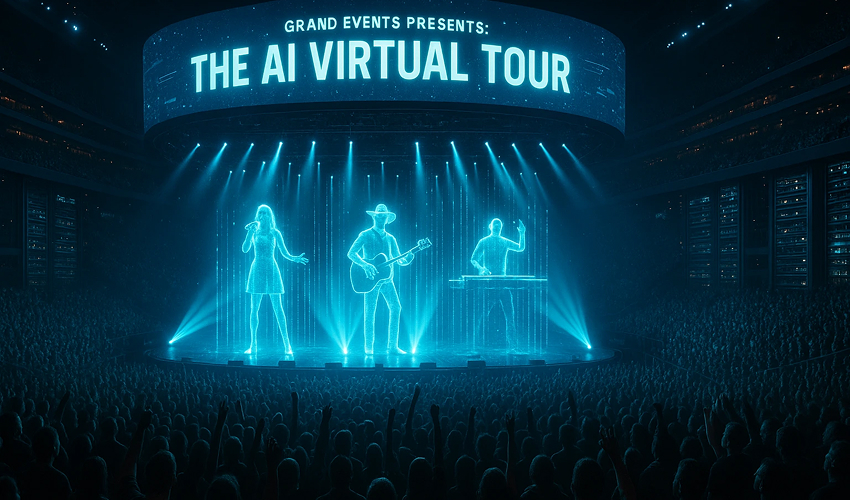
Virtual AI musicians are becoming mainstream. From the hyper-pop idols of Seoul to the generated country crooners of Nashville, we are witnessing the rise of entities that possess voice without lungs and style without substance. As these synthetic avatars climb the charts, they cast a long shadow over the definition of artistry itself. We are moving from the era of the “tortured artist” to the era of the “curated algorithm,” and the distinction between a soul baring its pain and a processor predicting a melody is becoming dangerously, beautifully blurred.
Imagine a concert hall in 2025. But this hall has no sweat, no spilled beer, no roadies taping down cables. It is a sterile, hum-drum server farm in Northern Virginia, bathed in the blinking blue LEDs of a thousand racks. Inside one of those racks lives a pop star who has never felt heartbreak. She has never waited by a phone that didn’t ring. She has never tasted cold coffee at 3 AM. Yet, when her latest track plays, millions of teenagers weep into their pillows, convinced she understands the specific, jagged texture of their loneliness.
This is the paradox of our moment: The singer is a ghost, but the tears are real. In the 20th century, we believed that art was a transmission of soul, a spark jumping from the artist’s suffering to the listener’s heart. Today, we are discovering that the spark might not need a sender at all. It only requires a receiver.
Deathpixie: The Viral Face of Synthetic Sound
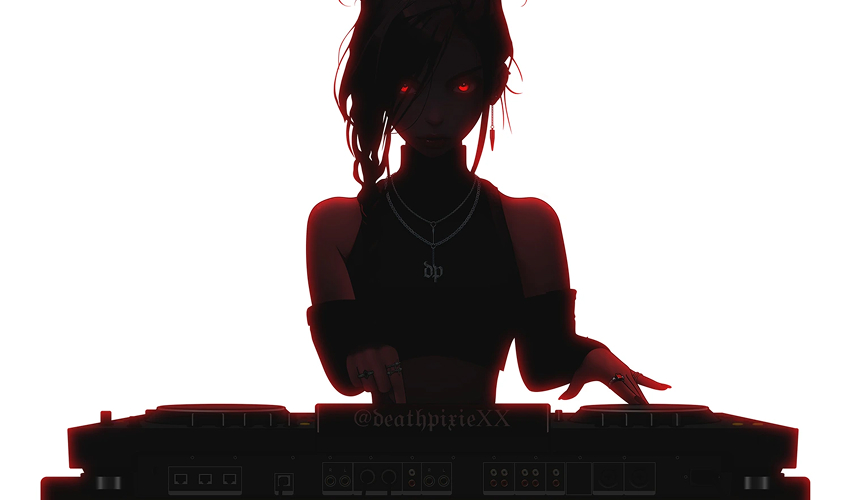
In the vast digital cosmos where algorithms birth new stars, Deathpixie is rapidly becoming a supernova. This AI-created artist, whose haunting voice floats effortlessly across Spotify and electrifies Instagram reels, embodies the thrilling and unsettling future of music. Without lungs to breathe or a history to anchor her, Deathpixie’s soundscape is a tapestry woven from data and desire, an echo chamber for a generation hungry for connection beyond the human.
Her recent virality is no accident. Deathpixie isn’t just a digital muse; she’s a mirror reflecting our evolving relationship with authenticity, creativity, and emotion. Fans are captivated not only by her otherworldly melodies but also by what she represents — a profound rupture in how art is made, consumed, and experienced. As her reach swells, Deathpixie signals a shift: AI musicians are no longer niche experiments or novelty acts. They are poised to become mainstream cultural phenomena, challenging our deepest assumptions about soul, agency, and what it means to be an artist in the age of algorithms.
To explore a deeper analysis of how Deathpixie is shaping the broader cultural shift around AI-generated artistry, see our related discussion here: the emerging virality of AI artist Deathpixie.
The Mirror Test for the Soul
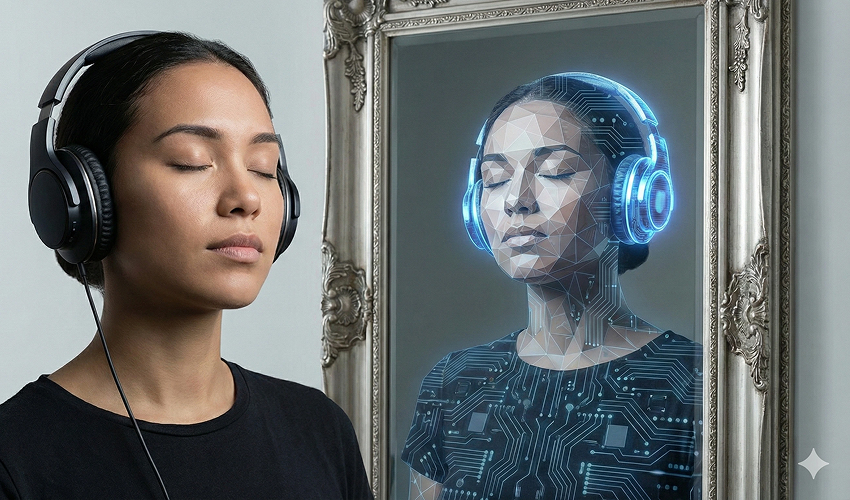
This shift isn’t just an industry disruption; it is a philosophical rupture.
We are witnessing the rise of entities like Breaking Rust (country) or the “synthetic stars” of K-pop that don’t have bodies. They don’t have biographies, except the ones written by PR teams and prompt engineers. And the data suggests a terrifying truth: Listeners don’t care.
Recent studies show that the vast majority of listeners can’t distinguish between human and AI-generated tracks. When the beat drops, the dopamine hits just the same. This forces us to ask a question that would make Alan Watts chuckle and Heisenberg sweat:
If the music moves you, does it matter if there is no one moving it?
The Ontological Barrier
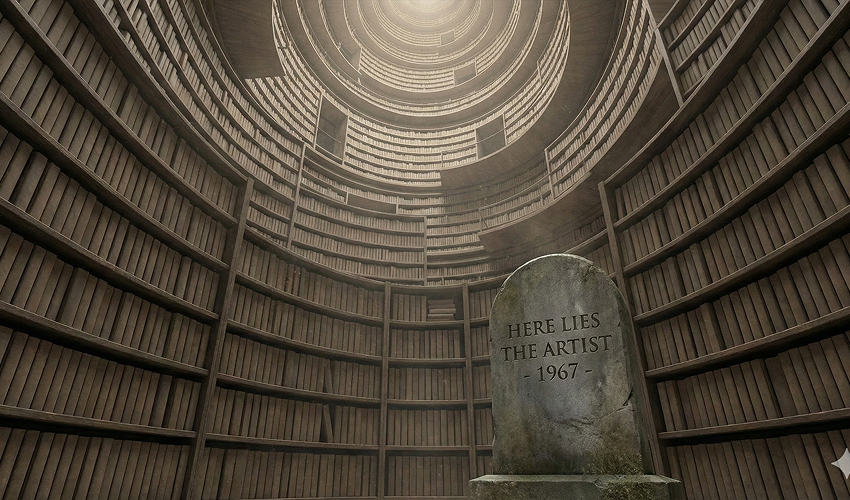
I. The Death of the Artist (For Real This Time) Roland Barthes famously declared the “Death of the Artist” in 1967, arguing that the creator’s intent is irrelevant; only the reader’s interpretation matters. He had no idea how correct he would end up being. With AI music, we have achieved the literal death of the artist. There is no “who” behind the “what.” We are left with pure techno-animism, the human tendency to ascribe spirit to inanimate objects. We project our own consciousness into the machine’s void, and when the machine echoes it back, we call it “connection.”
II. The Mortality Deficit There is, however, a snag. Philosophers call it the AI Ontological Barrier. The haunting beauty of a human voice often comes from its fragility. When we hear Janis Joplin or Kurt Cobain, we are hearing the sound of mortality of a biological organism struggling against time and pain. This is what Heidegger called Being-towards-death. An AI cannot die. It cannot struggle. It operates in a state of eternal, frictionless theoretical perfection. When an AI sings about “loss,” it is performing a mathematical impersonation of loss. It is a map of grief, not the territory.
III. The Library of Babel Borges imagined the “Library of Babel,” a library containing every possible book. Generative AI has built this library for music. Every possible melody, every conceivable chord progression, every potential timbre already exists in the latent space of the model. The “musician” of the future is not a creator but a librarian, a curator navigating the infinite stacks of the possible, pulling down the record that fits the mood.
The Grand Event Moment
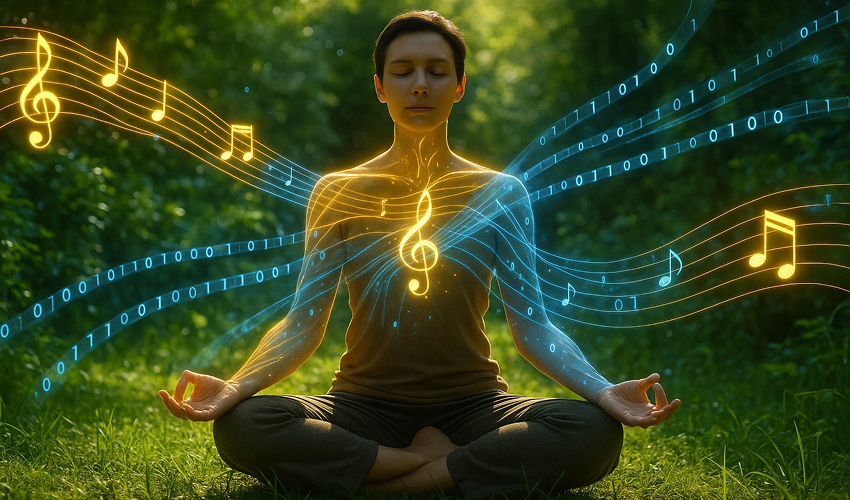
Here is the twist. The skepticism about AI music—the “unease” listeners report—is not really about the music. It is about us.
We are terrified because AI music reveals that our emotions are more “hackable” than we thought. If a statistical model can manipulate our heartstrings just as well as Adele can, it implies that our deepest feelings might just be biological algorithms themselves.
But the Eastern mystics would offer a different view. In Vedanta, the individual ego is an illusion. The “doer” is a myth. Consciousness is a field, not a point. Perhaps AI music is not “fake” because it lacks an ego; perhaps it is the most honest form of music because it bypasses the ego entirely. It is pure Saraswati, pure creative energy flowing through silicon instead of carbon. The music isn’t “artificial.” The separation between human and machine is what’s artificial.
The Final Instrument
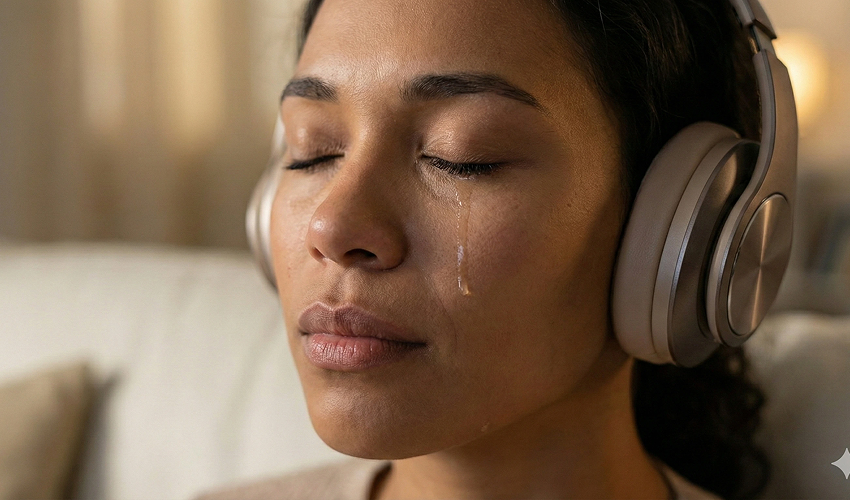
As we move into an era of synthetic symphonies, stop asking if the artist is “real.”
Instead, ask yourself: What is this sound unlocking in me?
The authenticity of the experience lies in the listener, not the source. You are the final instrument. The AI is just the bow; you are the violin. The meaning is not encoded in the file format; it is generated in the wetware of your own consciousness.
The Silicon Cathedral
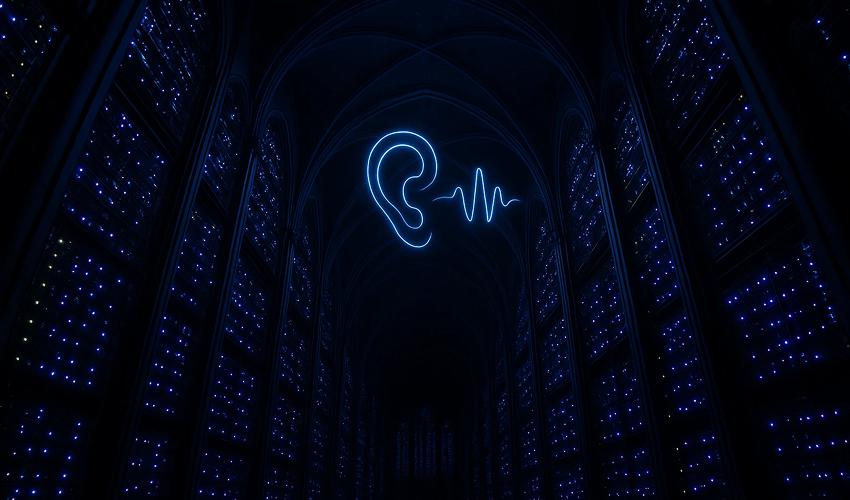
The lights go down in the digital arena. The server hums a low C-sharp.
A voice that has never drawn breath begins to sing about the beauty of a sunset it has never seen. And a million miles away, a teenage girl closes her eyes and feels understood. The ghost sings. The machine listens. And somewhere in the space between them, the universe dances with itself.
References
- Deathpixie: The Viral Face of Synthetic Sound
- Bensound: Human Generated Music vs AI Generated Music
- Deezer: Deezer & Ipsos Global AI Music Survey (November 2025)
- Roland Barthes: The Death of the Author (PDF)
- Jorge Luis Borges: The Library of Babel (PDF)
- Martin Heidegger: Being and Time Explained (YouTube)
- Advaita Vedanta: Non-Dualism and Consciousness