
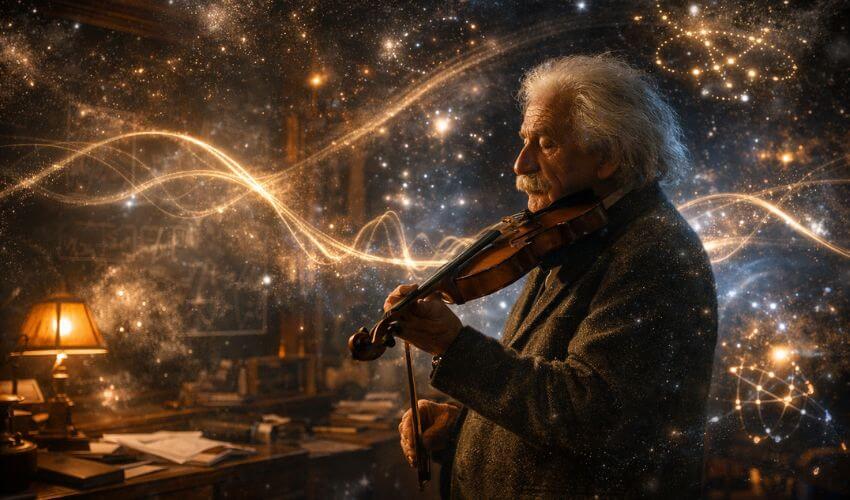
Einstein lifts the violin to his chin.
Not to perform. Only to listen.
The room is quiet. Equations rest unfinished on the desk, chalk dust suspended in thought. Outside, the universe hums with motions too vast and too small to see. Somewhere between wood and string, between tension and release, he senses it again. The intuition that reality itself is structured like music.
Not metaphorically. Literally.
For Einstein, the so-called Music of the Spheres was never poetic ornament. It was a clue. A way of thinking about harmony, resonance, and proportion as fundamental properties of existence. Long before quantum mechanics shattered classical certainty, music had already hinted at a deeper order. One based not on objects, but on relationships. Not on things, but on frequencies in motion.
That intuition never disappeared. It simply waited for technology to catch up.
Today, we are approaching a moment when music itself is beginning to behave less like a fixed artifact and more like a living system. One that responds, adapts, and collapses into form only in relation to the listener. The result is not a new genre, but a new ontology of sound.
A quantum symphony beyond the octave.
Why This Matters Now
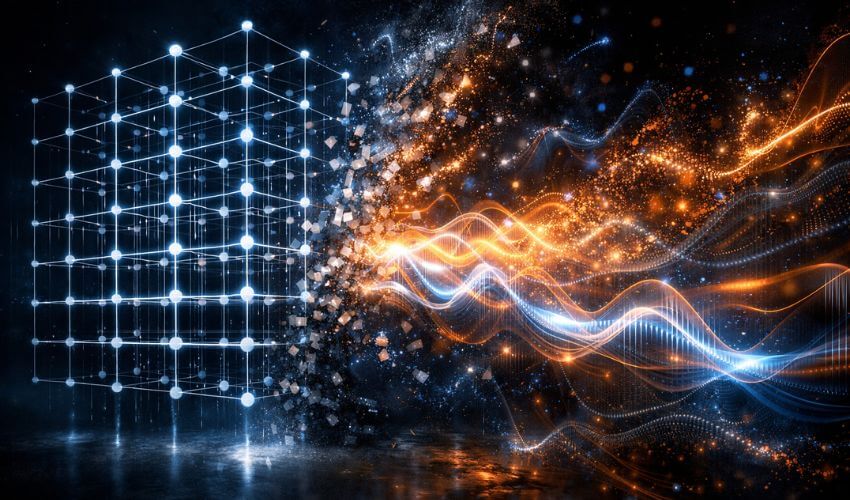
For centuries, music has obeyed a reassuring geometry. Twelve tones per octave. Frequencies doubling in clean ratios. A lattice of pitch stable enough to build entire civilizations of harmony upon. Cathedrals of sound rose from this structure. So did symphonies, pop songs, and national anthems.
This system worked because it solved a practical problem. Instruments needed to agree. Performers needed common reference points. Cultures needed a shared grammar. The twelve-tone scale was not inevitable. It was a compromise that favored repeatability over infinity.
Stability, however, was always a convenience. It was never a law of nature.
Sound itself does not arrive in discrete steps. It exists as a continuous spectrum of vibration. Between any two notes lies an uncountable field of possible frequencies. Human hearing, instrument design, and cultural habits compressed that continuum into manageable units.
Now, that compression is loosening.
Advances in sensing technology, machine learning, and real-time signal processing are allowing music to break free from fixed playback. New platforms are experimenting with what can best be described as Quantum Probability Audio. These systems do not store a single, finalized version of a track. Instead, they store a field of sonic possibilities.
The music only becomes definite when it is heard.
Heart rate variability. Breath cadence. Micro fluctuations in neural activity. Subtle physiological signals that once went unnoticed are now measurable in real time. The listener no longer presses play and receives a static output. The listener participates in the formation of the sound itself.
The observer does not consume the music.
The observer completes it.
Beyond the Twelve-Tone Cage
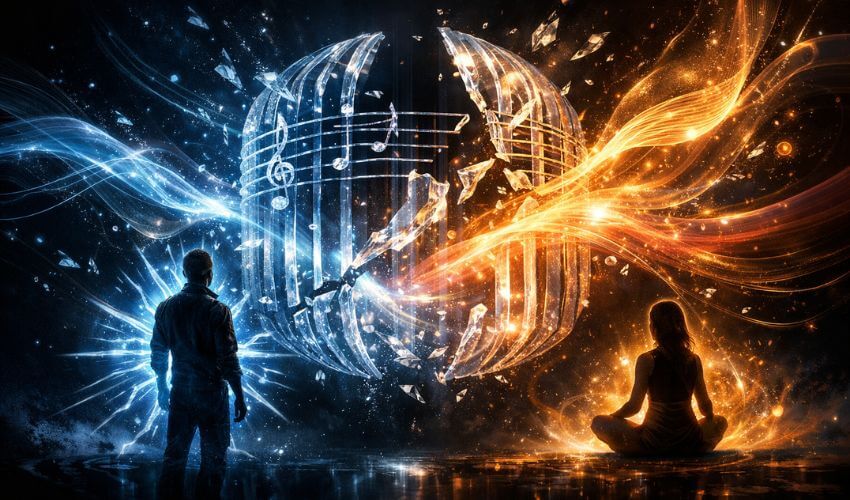
The twelve-tone scale was a triumph of coordination. It allowed orchestras to synchronize and global cultures to share musical ideas. But it also flattened vast sonic terrain. Infinite variation was folded into twelve repeatable steps per octave. Emotional nuance was expressed through combinations rather than continua.
This constraint shaped everything. Harmony theory. Instrument construction. Recording technology. Even though we emotionally categorize sound.
Major feels bright. Minor feels dark. Dissonance resolves into consonance.
Quantum audio systems reverse this logic from the ground up.
Instead of notes, they operate with probability fields. Instead of fixed compositions, they work with sonic wavefunctions. Each moment of listening triggers a collapse from possibility into perception. The system does not ask which note comes next. It asks, given this listener, in this state, in this environment, which version of the music becomes real.
Two people can listen to the same piece at the same time and hear fundamentally different outcomes.
An anxious listener may experience tightening textures, unstable harmonic clusters, or rising spectral density.
A calm listener may hear openness, extended resonances, and spacious harmonic intervals.
The composition remains the same in structure, but not in manifestation.
This is not randomness. It is responsiveness.
The music is not reacting to conscious choice, but to embodied state. It listens to the listener.
Observation as Participation
Quantum mechanics introduced a deeply unsettling idea to twentieth-century physics. Observation is not passive. Measuring a system alters it. There is no neutral vantage point outside reality.
Particles behave differently when observed. Wavefunctions collapse. Certainty replaces probability, but only at the cost of excluding other possible outcomes.
Music is beginning to absorb this lesson.
In biometric-driven sound environments, the act of listening becomes an intervention. You cannot hear the track without shaping it. You cannot stand outside the experience. The music you perceive is inseparable from the state you bring into the room.
This is Heisenberg made audible.
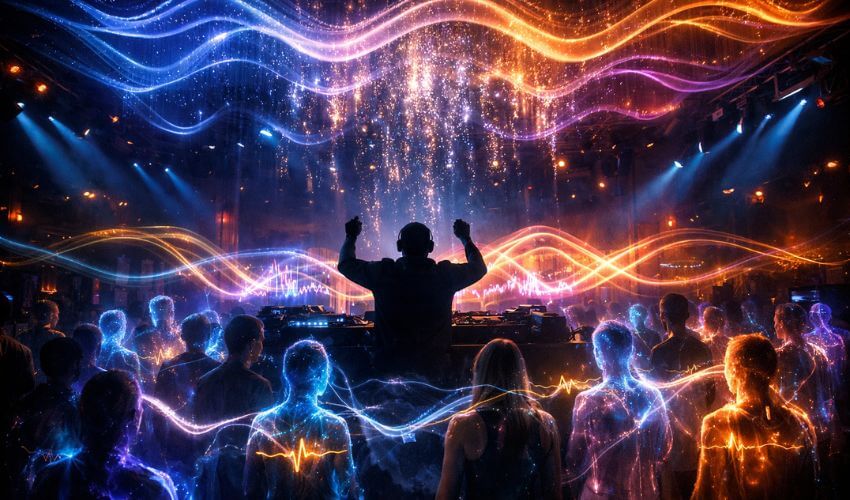
The dance floor becomes a laboratory. The concert hall becomes an experiment in collective measurement. Each body present adds variables. Each nervous system contributes noise, rhythm, and constraint.
What DJs have done intuitively for decades is now being encoded at the level of physiology. Reading a room. Adjusting tempo. Modulating energy. Responding to subtle shifts in crowd attention.
Algorithms are not replacing that intuition. They are formalizing it. They are translating embodied feedback into continuous sonic modulation.
The result is not mechanical. It is emergent.
Music as a Relational System
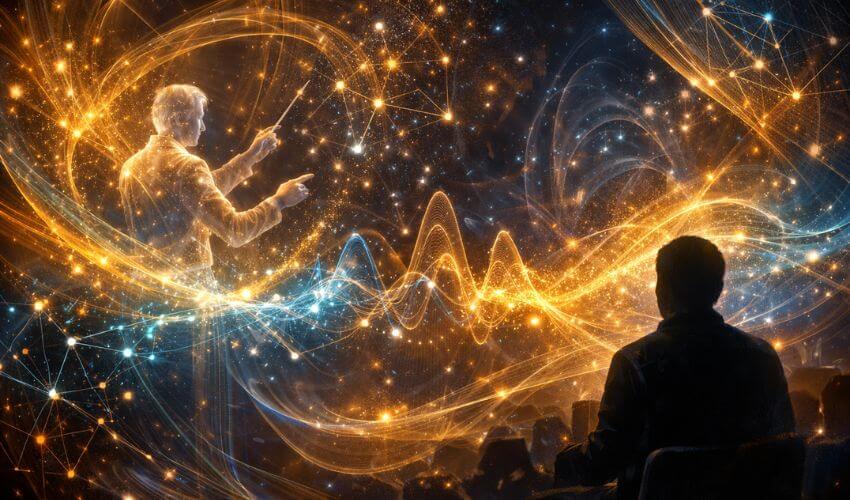
For most of recorded history, music has been treated as an object. A score. A file. A track with a beginning, middle, and end. Something you can own, replay, and archive.
Quantum-inspired systems challenge this assumption.
Music becomes relational rather than object-based. It exists between the system and the listener. Between intention and perception. Between probability and collapse.
This reframes authorship. The composer is no longer the sole determiner of outcome. Instead, they design a space of possibility. A set of constraints, tendencies, and attractors.
The listener becomes a co-author, not through choice, but through presence.
This does not diminish artistic intent. It deepens it. Composers shift from dictating sequences to shaping behaviors. From writing notes to designing conditions under which sound evolves.
The music is not finished when it is released. It is finished every time it is heard.
The End of Passive Listening
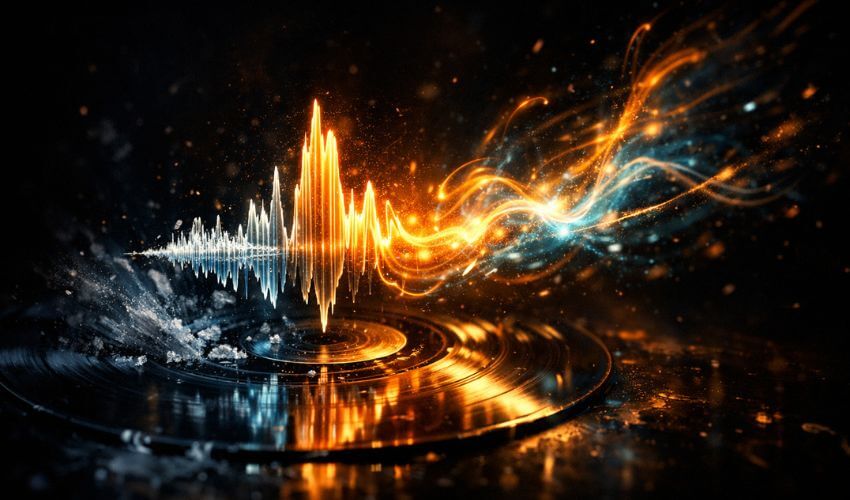
Recorded music has trained us to be passive recipients. We press play. The sound unfolds the same way every time. Repetition becomes familiarity. Familiarity becomes comfort.
This mode of listening shaped modern culture. It enabled mass distribution, global hits, and shared reference points. It also narrowed the role of the listener to that of a consumer.
Quantum audio systems disrupt this habit.
There is no definitive version to memorize. No canonical take. Each listening session is singular. Attention matters again. So does mood. So does breath.
Music regains something it had before recording technology froze it in time. Liveness.
But this is not a return to pre-modern performance. It is a new hybrid. A system that is repeatable in structure but not in outcome. Stable in intention, fluid in expression.
Listening becomes an act rather than a background condition.
Cultural Implications Beyond Music
The implications extend far beyond sound.
We live in a world increasingly shaped by adaptive systems. Recommendation algorithms adjust feeds in real time. Interfaces respond to behavior. Environments sense and react.
Music is one of the first art forms to openly embrace this shift at the level of ontology. Not just distribution, but existence itself.
When art becomes observer-dependent, it mirrors how reality behaves at its most fundamental level. Relational. Contextual. Indeterminate until engaged.
This has consequences for how we think about identity, authorship, and experience. If the same artwork manifests differently for different people, then meaning itself becomes distributed. Not relativistic, but participatory.
There is no single truth of the piece. There are many valid collapses.
Music, Mathematics, and Feeling

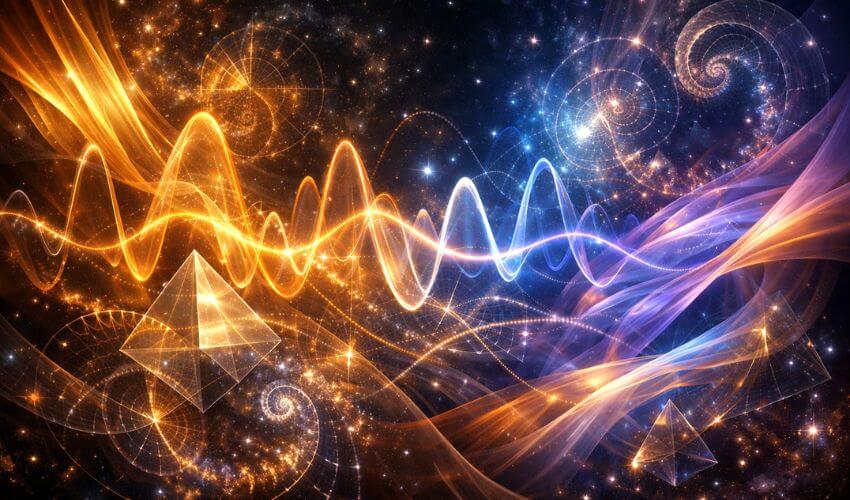
From vibrating strings to electromagnetic waves, the universe speaks in oscillation. Ratios govern harmony. Interference creates a pattern. Resonance amplifies structure.
Music has always been mathematics made audible. What changes now is that mathematics begins to feel.
Probability amplitudes become emotional gradients. Statistical variation becomes expressive nuance. Equations stop being abstract and start being embodied.
When sound responds to physiology, mathematics crosses into affect. It does not describe feeling. It generates it.
Music returns to its deepest role. Not entertainment layered onto reality, but reality expressing itself through relation.
Explore the evolving relationship between sound and mathematics for a deeper understanding of how music moves beyond fixed patterns.
A New Way of Listening
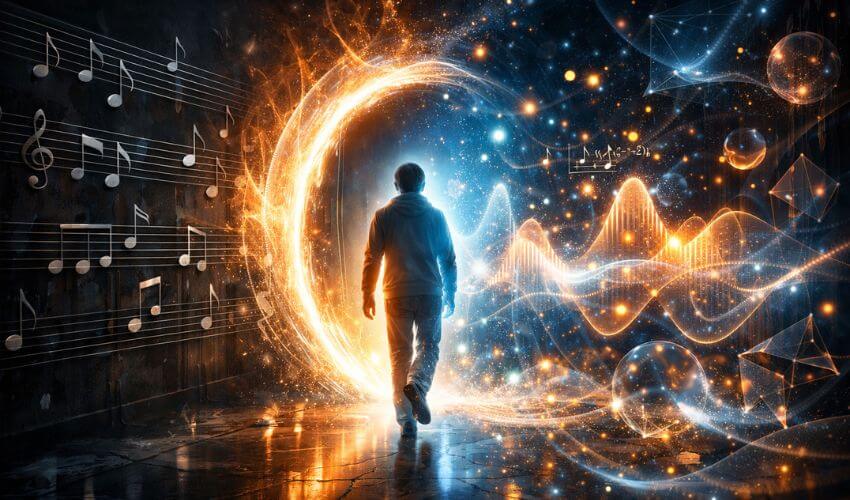
We are moving away from songs you play.
Toward systems you enter.
Away from fixed compositions.
Toward living equations.
The future of music is not post-human. It is post-passive.
It does not erase tradition. It reframes it. The octave does not disappear. It becomes optional. One structure among many, rather than a cage.
Listening becomes a form of participation. Presence becomes audible. Silence becomes a variable again.
Trace the techno movement’s journey through cultural shifts and technology to see how music adapts and evolves with its listeners.
After the Last Note Never Lands
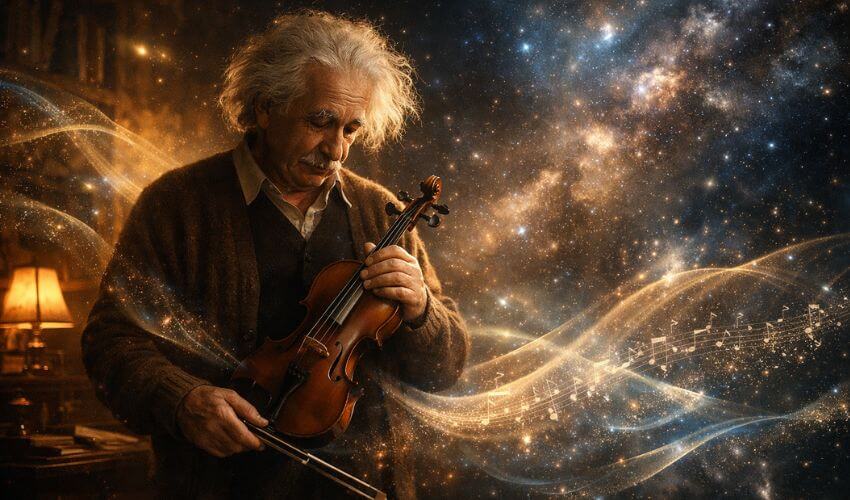
Einstein lowers the violin.
There is no applause. No resolution chord waiting to tell him the piece is complete. Only the lingering sense that the universe was never performing for us.
It was performing with us.
A quantum symphony without an octave.
A score written in probability.
Waiting for an observer to breathe.
And begin.
References
- Towards the Intuitive Understanding of Quantum World
- Quantum Concept Music Score from Quantum Picturalism
- New Directions in Quantum Music
- Quantum approaches to music cognition
- Quantum information, cognition, and music
- Towards Quantum Computing for Audio and Music Expression
- Quantum Computer Music: Foundations, Methods and Advanced Concepts
- Generative Music with Partitioned Quantum Cellular Automata