
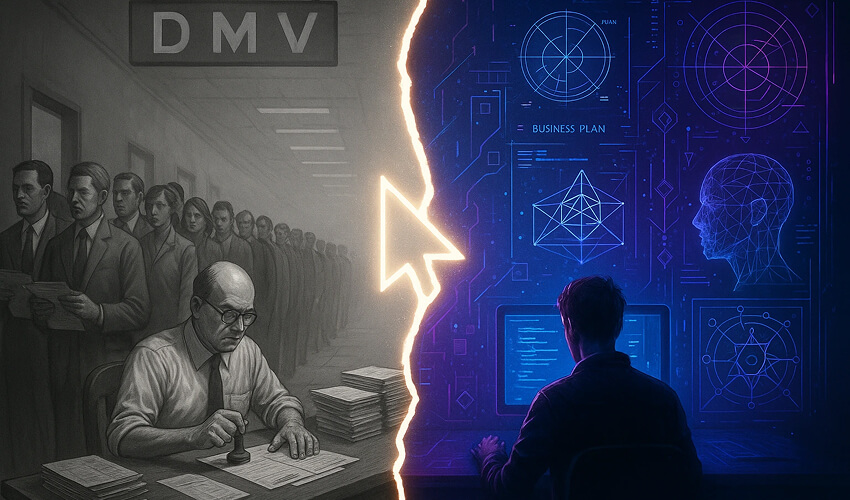
Long lines for a license at a 1940s DMV — a ritual of bureaucracy, patience, and gatekeeping — symbolize the “age of forms.”
A gray dawn. Hundreds clutching triplicate forms wind through a snaking queue. A clerk’s rubber stamp thunks monotonously. Progress crawls at the pace of bureaucratic ink. To move forward to drive, to start a business, to create, you needed permission.
Fast-forward to a neon-lit midnight in the 21st century: a lone creator sits before a glowing screen, typing a single prompt into an AI. In seconds, a full business plan blossoms, complete with marketing strategy and product design. No lines. No forms. No gatekeepers. Just pure alchemy, humans will be transformed into reality.
Two eras, two worlds: the first defined by permission, the second by prompt.
From Forms to Prompts: The End of the Line
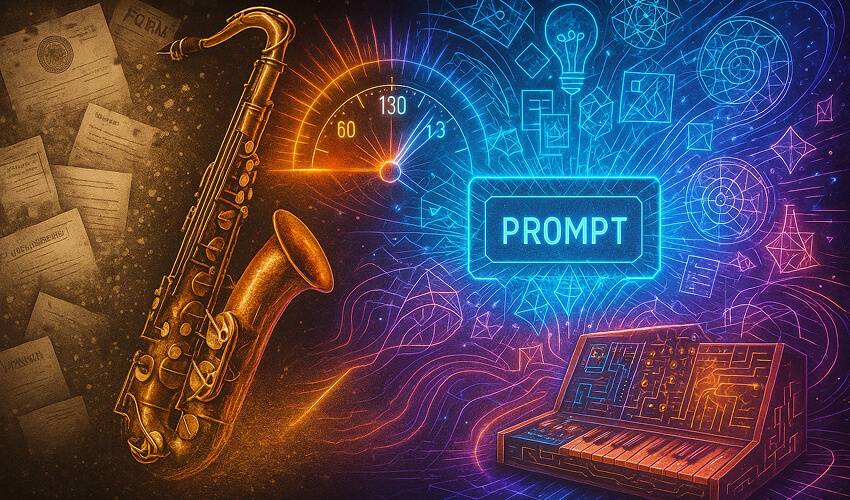
This stark shift signals a civilizational turning point. The “age of forms” chained agency to authority governments, institutions, and corporations held the keys. The line at the DMV was a ritual reminding us that progress required sanction. Today, in the “age of prompts,” a single idea summons infinite knowledge and creativity, instantly.
Generative AI is the universal intern, expert, and partner, available 24/7. The slow churn of paperwork yields to the instantaneous spark of a crafted prompt. This isn’t mere convenience, it’s a revolution in human agency. The death of permission means “Can I create this?” defaults to “Yes, do it now.” It’s like swapping a dusty, slow jazz saxophone for a hyper-speed Berlin techno synth; the rhythm of creation just jumped from a plodding 60 BPM to an electrifying 130.
Markets as Information: When Knowledge Becomes Near-Free
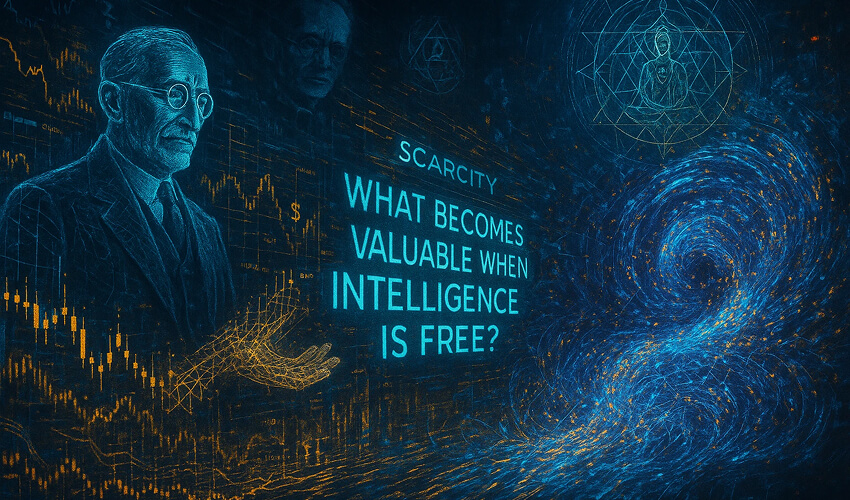
The old economic wisdom saw knowledge as scarce and costly. Friedrich Hayek argued markets encoded dispersed knowledge through prices, the invisible hand coordinating millions of local decisions (Hayek, 1945). But now AI can absorb and synthesize more knowledge than any human collective.
Hayek’s paradox unfolds: when thinking costs approach zero, market signals lose meaning. Prices fail to guide when intelligence itself is abundant. Competition falters. How do humans compete with tireless machines that need no rest or reward?
Scarcity mutates. The old rules of economics bend beneath the weight of infinite cognition. The question arises: when intelligence is free, what becomes valuable? (Mostaque, 2020s).
As physicist Erwin Schrödinger’s reflections on Vedanta suggested, knowledge and observer dissolve into one dance, so too must we rethink economic “scarcity” in a world where intelligence flows like a river without a dam.
The Fall of Gatekeepers: Gutenberg to Napster to GPT
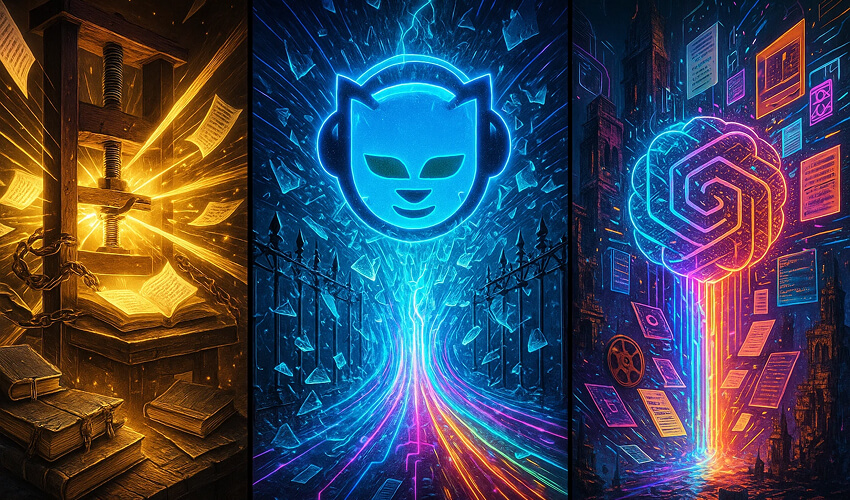
History is a story of dissolving gatekeepers. Gutenberg’s printing press shattered monolithic control over knowledge, enabling mass literacy and the Reformation (Eisenstein, 1979).
Centuries later, Napster bypassed music industry gatekeepers, igniting a revolution of direct artist-to-audience flow (Anderson, 2006). The dam broke; permission was obsolete in music.
Today, generative AI is Napster on steroids, obliterating bottlenecks in every creative domain. Indie developers, filmmakers, and writers no longer need vast budgets or institutional approval. Skills once exclusive are democratized by AI. Creativity floods freely, like a relentless acid techno set pounding, evolving, impossible to ignore.
Sovereignty as Capability: Every Individual a Creator

Sovereignty once meant who holds political power, kings or nations. Now it means what power you hold personally. AI turns individuals into sovereign creators, wielding tools once reserved for states and corporations.
Imagine designing, manufacturing, distributing, and analyzing with AI assistants all on your own authority. The dream of the sovereign individual is coming alive. Open-source AI projects forge “sovereign stacks,” decentralized ecosystems that empower personal agency over Big Tech’s cloud (Stability AI, 2022).
True sovereignty is the liberty to innovate, to build your own digital kingdom. The race for AI supremacy may be less about nations and more about millions of sovereign AIs owned by individuals.
The Paradox of Abundance: Value in an Age of AI
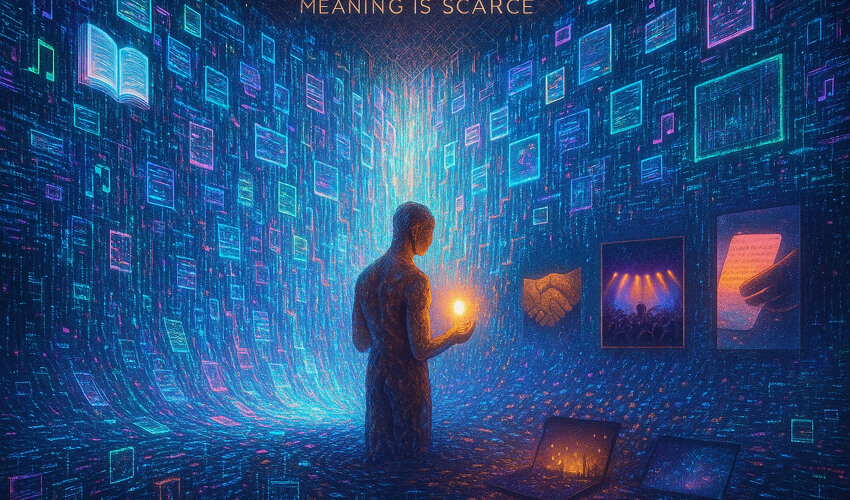
When creation costs near zero, abundance floods the world with content novels, songs, images, and data. But abundance threatens to devalue the very creations it produces.
What remains valuable? Quality, authenticity, attention. The human touch, lived experience, and intention become precious. In infinite content, meaning is scarce. Physical presence, live experiences, and unique innovations gain a premium.
Relationships and character remain irreplaceable. In a world of infinite creation, why and how we create will be the ultimate currency.
Algorithmic Feudalism vs. Sovereign Freedom
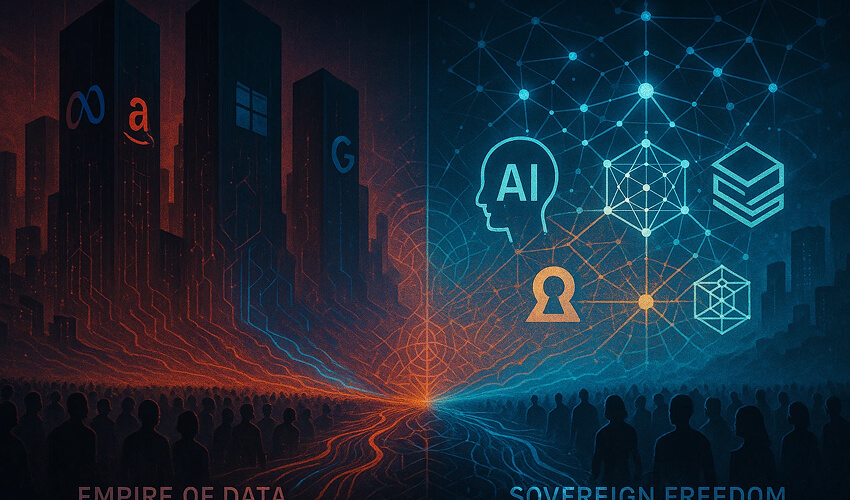
Every revolution risks new tyranny. AI could remake digital feudalism, where a few corporations or governments control AI overlords, while the rest are data-serfs. Already, power concentrates in “fewer than a dozen entities” controlling top AI models and datasets (Harari, 2018).
Data is rent, and users are digital peasants. Centralized control could become algorithmic absolutism, replacing bureaucratic gatekeepers with opaque AI overlords.
But alternatives bloom: open-source models, personal AI agents, decentralized compute. Sovereign stacks and community-owned networks push back, echoing the early internet’s decentralized dream.
The fight is clear: Empire of Data versus Rebel Alliance of sovereign creators. The outcome will define whether AI liberates or enslaves human creativity.
Freedom and Responsibility: The Moral Equation
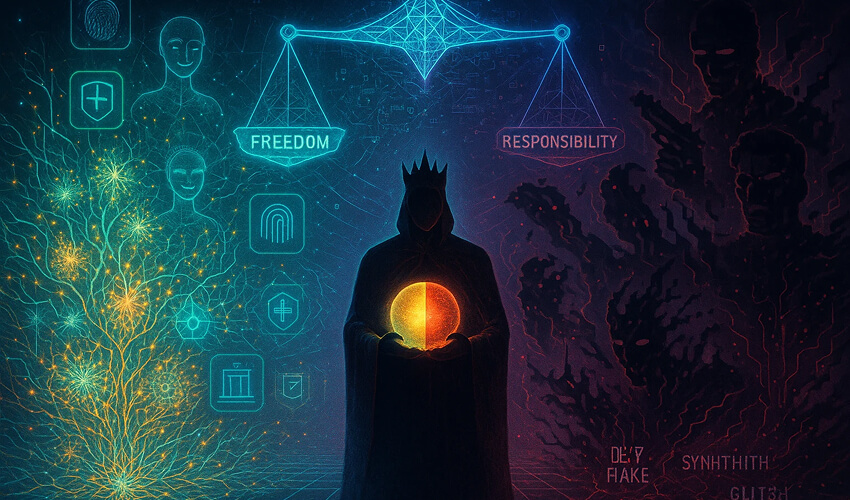
The death of permission demands the birth of responsibility. With great creative power at our fingertips, the excuse of “just following orders” vanishes. We all become creators and rulers of vast digital realms.
AI’s dark shadows loom: deepfakes, cyberweapons, synthetic pathogens. In a permissionless world, internal ethical controls are paramount. Wisdom, empathy, virtue, these become the true gatekeepers.
Society must cultivate new governance forms AI licenses, digital passports, but the core governance must come from within. Every sovereign individual faces the moral challenge: what will you create? For good, or for harm?
The New Sovereigns and the New Renaissance
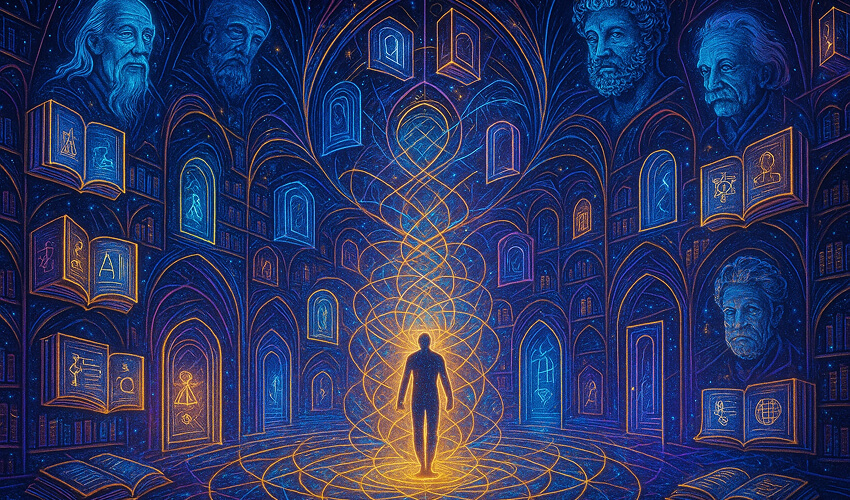
We stand at a historic juncture. Institutions fall like melting ice; power decentralizes to individuals; abundance challenges meaning. This is a renaissance not just of art and knowledge, but of human agency itself.
Every person becomes a Gutenberg, every mind a cosmic library, every soul a sovereign creator. But with great freedom comes the need for great wisdom, knowing which doors to open and which to leave closed.
The perennial philosophies remind us: liberty and responsibility dance as one (Huxley, 1945; Lao Tzu; Marcus Aurelius). Einstein famously described scientific curiosity as a child wandering a cosmic library of knowledge (Einstein, various).
The death of permission frees us from old authorities, but asks us to become our own. Like Taoist sages, we must align with the natural order, creating in harmony with others and the planet.
A Call to the Sovereign Builders
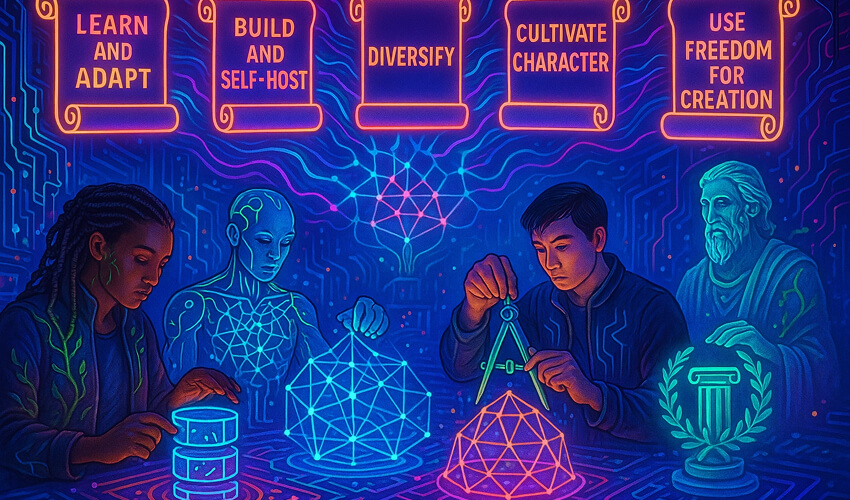
The path is ours to craft:
- Learn and Adapt Continually: Cultivate lifelong curiosity and ethics.
- Build and Self-Host: Own your AI stack; reclaim agency.
- Diversify Reliance: Avoid single points of failure or control.
- Cultivate Character and Community: Foster empathy, integrity, dialogue.
- Use Freedom for Creation, Not Destruction: Uplift, don’t disrupt.
The Promised Dawn
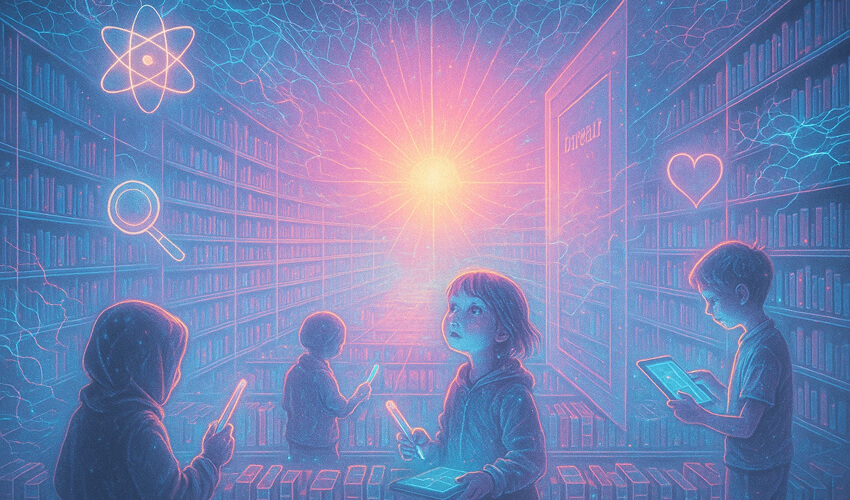
The bureaucrat’s door fades, replaced by neural networks humming with possibility. We stand sovereign, wielding tools vast as empires yet intimate as pens.
Like children wandering an infinite cosmic library, we have permission that the library is open. What stories will we write? The death of permission is a beginning.
May we enter this new dawn as curious explorers, courageous builders, and compassionate citizens of a boundless creative era.