
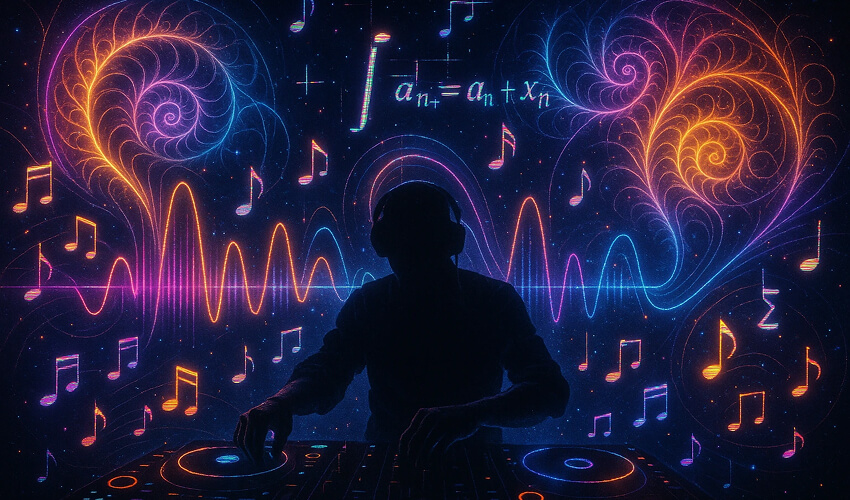
On a crisp Berlin midnight, a techno nightclub pulses like a living organism. LED strobes sketch geometry in swirling smoke. The DJ layers tracks with surgical precision: a steady 4/4 kick drum under polyrhythmic hi-hats, synthesiser arpeggios weaving counterpoint above a sub-bass fugue.
Imagine Johann Sebastian Bach, time-travelling from the 18th century, stepping into this temple of sound. Amid the alien electronic beats, he smiles. The interlocking melodies and loops follow a logic he knows by heart, the fugal dance of theme and variation, tension and release.
Across centuries and genres, Bach and the ravers commune in an invisible code: music’s mathematical patterns dressed in digital sound. But why does this abstract code strike so deeply in us? What secret does Bach sense beneath the pulsing polyrhythms?
To explore, we trace the path from math → pattern → emotion → cosmos → personal practice. Music is both a calculus of sound and a cosmic play of harmony.
The Mathematical Skeleton of Music
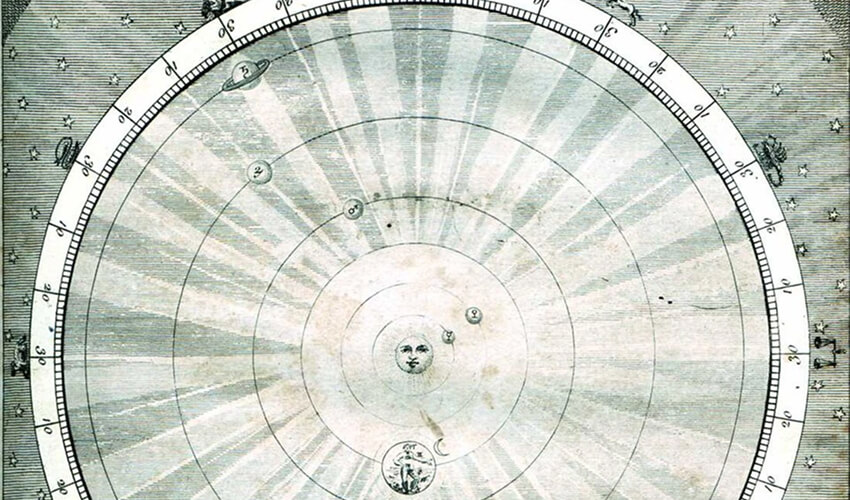
Ancient philosophers saw music as a manifestation of cosmic order. Pythagoras revealed that harmony arises from simple ratios: a string halved leaps an octave (2:1); shortened to two-thirds, a perfect fifth; three-fourths, a perfect fourth. These ratios form the skeleton of consonance, the backbone of music.
The Pythagoreans imagined the “music of the spheres,” a silent cosmic symphony played by planets orbiting in harmony. This idea captures a profound truth: nature loves patterns, and music is patterned nature made audible.
Rhythm, too, is arithmetic in time. A drumbeat is a binary sequence of hits or rests cycling modularly like numbers on a clock. Polyrhythms overlay cycles of different lengths: a 3-beat pattern against 4, aligning every 12 beats. These patterns are gears clicking in time, a dance of fractions manifest.
Harmony’s journey through chords is an abstract geometry, a path in “harmonic space.” Songs wander from “home” chords through tension and back, creating emotional voyages we feel but rarely map. Bach’s fugues, architectural and rule-bound, embody this mathematical artistry.
Leibniz called music “a hidden arithmetic exercise of the soul, which does not know it is counting.” We count music unconsciously, feeling its structure, not solving equations.
Pattern, Pleasure, and Play
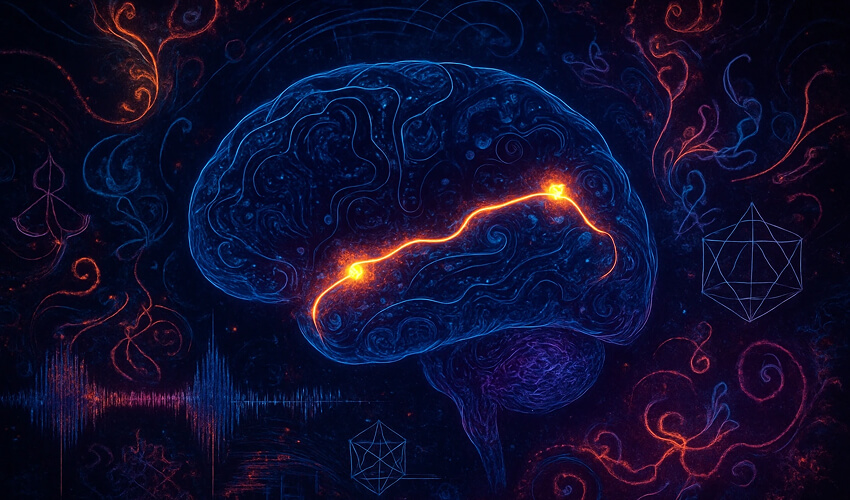
The brain is a prediction machine, forever seeking patterns. Music plays this beautifully, setting up expectations and then confirming or surprising them. This tension and resolution trigger dopamine, the neurotransmitter of reward.
When a melody climaxes, when a bass drops, the brain’s reward centres light up, rewarding prediction and delight. Music’s emotional calculus balances expectation and deviation, engineering catharsis through sound.
At a deeper level, music may mirror the universe’s own playful creativity. Hindu philosophy’s Līlā calls existence divine play, a cosmic game of joyful pattern-making. Our dopamine rushes echo the universe’s joy in creating order from chaos.
Nada Brahma holds the universe itself as vibration and sound. The pleasure from music’s mathematics is a hint: pattern is woven into reality’s fabric. When we find harmony, we touch fundamental meaning.
Resonance of Matter and Mind
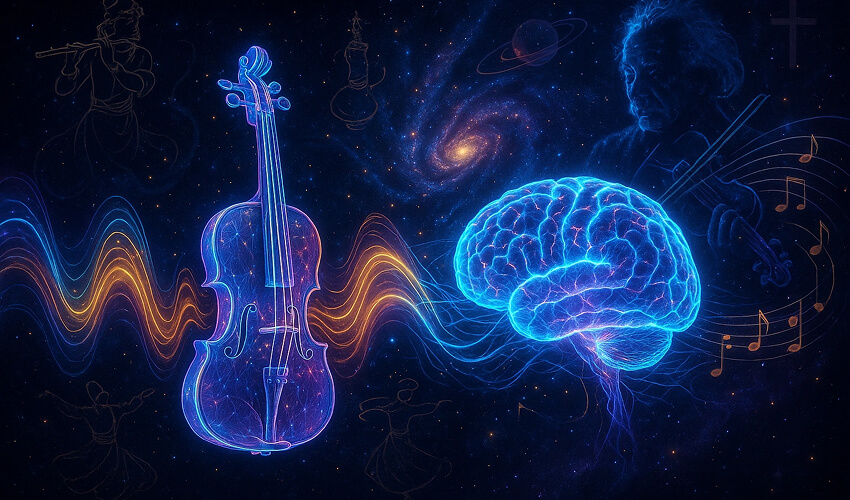
Physically, music is vibrating air waves, triggering neural patterns. Yet, consciousness transforms this mechanical chain into rich qualia, and sound becomes feeling.
In a famous 1930 debate, Einstein and Tagore discussed whether beauty exists independently or only within the mind. Tagore argued for participatory reality, where beauty arises when cosmos and consciousness resonate.
Music is this resonance: vibrating molecules meeting the brain’s craving for pattern, producing beauty and meaning. Spirit and physics collapse in sound.
Across cultures, music is sacred from Krishna’s flute to Sufi whirls to biblical creation myths. Music bridges earth and heaven, matter and mind.
Einstein, an avid violinist, intuited that the same patterns governing planets also shape Mozart’s sonatas. Music whispers a cosmic secret: the universe is a melody, and we are tuned to listen.
The Mystic-Mathematician on the Dance Floor
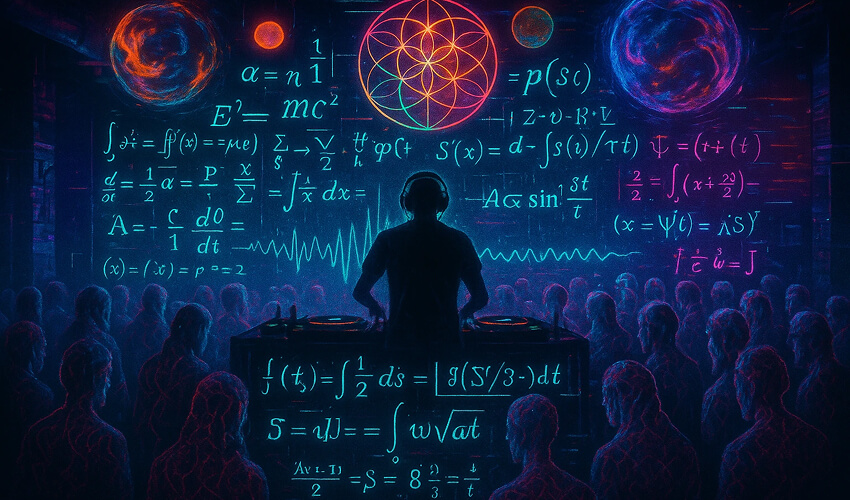
Musicians are emotional mathematicians, solving equations in feeling. A DJ in Berlin juggles tempo, rhythm, tension, and release, solving for maximum euphoria. They experiment with structure, tuning the crowd’s energy like scientists running feedback loops.
Listeners are mystic-mathematicians too, engaging analytical and spiritual faculties. Noticing patterns, the inverted chorus, a polyrhythm, and chord progressions climbing in fifths deepens awe. Surrendering to the feeling brings transcendence.
Playlists are microcosms, emotional universes we curate. From energetic openers to reflective middles, they mirror life’s chaos and order, love and loss, math and magic.
Why We Love Music: A Cosmic Unity
Music satisfies multiple levels: logic and emotion, individual and collective, human and cosmic. Those same ratios that make chords consonant describe planetary orbits and sunflower spirals.
We align our neuronal rhythms with the universe’s vibrations. Music reminds us that beneath surface differences lies fundamental unity.
Bach said music’s aim is “the glory of God and refreshment of the soul.” In a Berlin club, that essence lives on in techno beats and baroque fugues alike.
Science and spirituality, math and mysticism, two hands clapping to the beat. Music is both equation and poem, structure and story.
As the final note reverberates, we are children in a cosmic playground of pattern and play, learning through music how to love the universe.
Dancing with the Cosmic Pattern
Music is more than melody or rhythm; it is the language where mathematics meets mystery, where cosmic order vibrates through human feeling. From Pythagoras’s simple ratios to the dopamine-fueled rush of a techno drop, music bridges the external universe and our internal experience.
It invites us to recognise the invisible patterns that underlie both planets and playlists, beats and brainwaves. In music, logic and emotion, science and spirit, matter and mind do not clash but dance together, two hands clapping to the cosmic rhythm.
As listeners and creators, we are mystic-mathematicians, tuning our consciousness to the universal symphony. Every song, every set, every playlist is a microcosm of this grand dance, inviting us to feel connected, to play, to celebrate the beautiful order emerging from chaos.
So next time you hear a beat that moves you, remember: you are not just listening to sound. You are participating in a timeless dance of pattern and play, a living proof that the universe itself is music. And in that moment, you become a co-creator of the cosmic song.
References
- Musica universalis (Music of the Spheres) – Wikipedia
- How Music Resonates in the Brain | Harvard Medicine Magazine
- Pleasurable music affects reinforcement learning according to the listener – PubMed
- Cosmic Play: Līlā (Swami Tyagananda) — Ramakrishna Vedanta Society
- Basics of Nada Brahma: The Eternal Sound – Alchemy Sound Studio
- Einstein & Tagore on Truth: A Historical Dialogue (summary)
- The arithmetic of music – PS Audio
- Bach and Mathematics | Yale University Project