
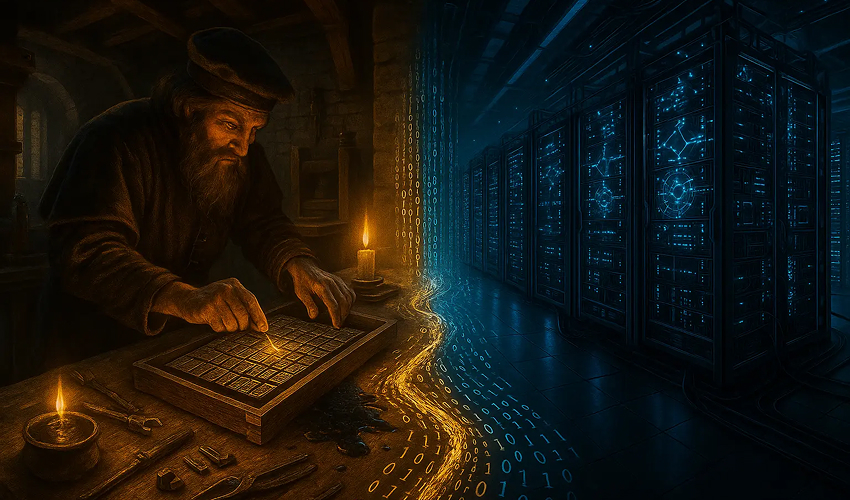
Imagine Johannes Gutenberg standing in his dim workshop in Mainz, the scent of molten metal mixing with candlewax. On his desk rests a block of movable type, tiny, metallic symbols destined to rearrange the human mind. He cannot know it yet, but he is carving a portal. His press will become a wormhole through which civilization escapes the gravity well of the Middle Ages and accelerates toward modernity.
Now zoom forward six centuries.
A neural network hums in a data center, rows of servers glowing like a mechanical monastery. In this place, language is not printed; it emerges. Meaning is not carved into lead; it flows through billions of parameters. And yet: the feeling is the same.
A hinge in history clicks open.
Gutenberg pressed ink into paper. LLMs press possibility into thought.
A new revolution begins.
Knowledge in Chains — Before the Machines of Thought
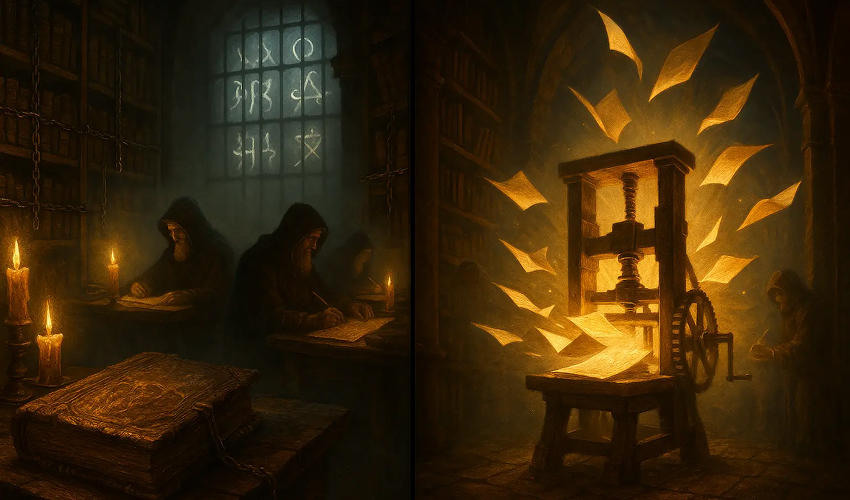
For most of human history, knowledge lived behind locked doors. Medieval Europe treated information the way ancient temples treated fire: sacred, dangerous, and limited to an initiated few. Books were rare creatures, hand-copied, fragile, bound in leather like tamed beasts. Monks spent decades transcribing a single text; a single mistake could ripple across generations of copies.
Ideas moved slowly, like lantern light crossing a vast, foggy field. A radical insight could remain trapped in a single monastery for centuries, like a brilliant prisoner condemned to silence.
Humanity was intelligent, but the infrastructure for intelligence was starved.
And then: click.
A press. A mechanism. A simple machine that turned scarcity into abundance and silence into symphony.
Gutenberg: The First Information Supernova
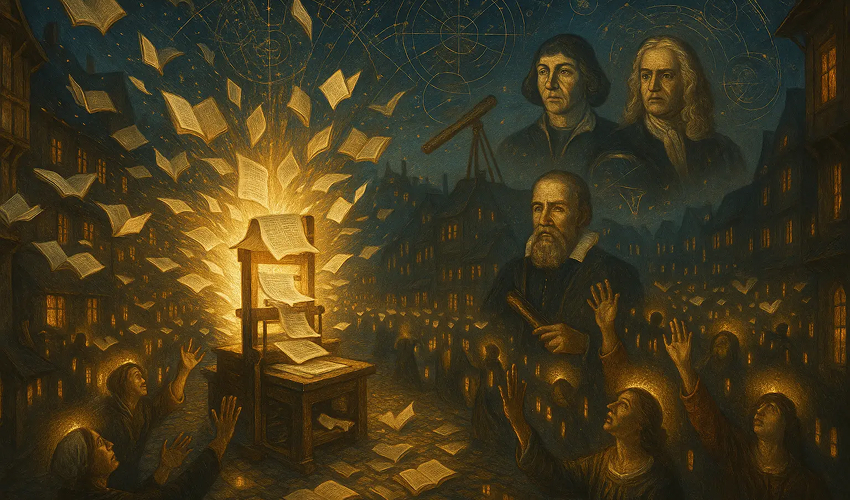
When the first pages rolled out of Gutenberg’s press, it was as if Europe inhaled for the first time.
Books multiplied. Literacy rose, and the membrane separating the masses from knowledge dissolved. And once people could read, they began to think for themselves. From that chain reaction emerged the Reformation, the Scientific Revolution, and the Enlightenment, all powered by ink arranged into patterns that traveled across borders at unprecedented speed.
Knowledge became viral long before we had the word.
It’s no coincidence that Copernicus, Galileo, and Newton, the architects of the modern worldview, lived within the first centuries after printing. Their work was not just brilliant; it was distributable. And the universe, once interpreted only through scripture, opened into a mathematical poem shared across continents.
Gutenberg’s machine didn’t just print books; it printed modernity.
The Digital Wave — The Internet as the Second Supernova
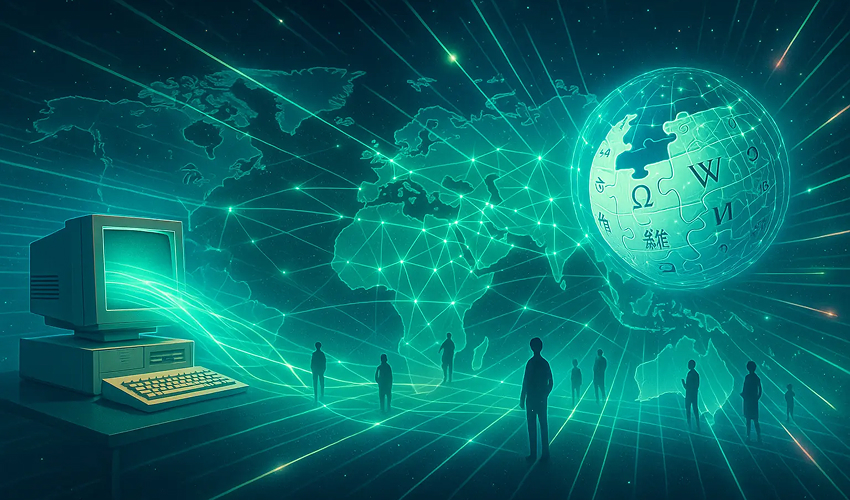
Fast-forward to the late 20th century: another silence breaks.
The personal computer reduces computation to a desk-sized companion. The internet dissolves geography. A student in Manila gains instant access to the same libraries as a professor in Oxford. A billion minds plug into a planetary nervous system. Wikipedia emerges, not a book, but a breathing organism of collective knowledge.
The printing press democratized access. The internet democratized participation. Ideas began moving at the speed of photons. Knowledge became a shared frequency.
Yet there was still a bottleneck: us.
Humans had to search, read, sort, and synthesize. Our eyes became the limiting reagent in an accelerating world.
LLMs — The Third Supernova: Intelligence That Talks Back
Enter LLMs.
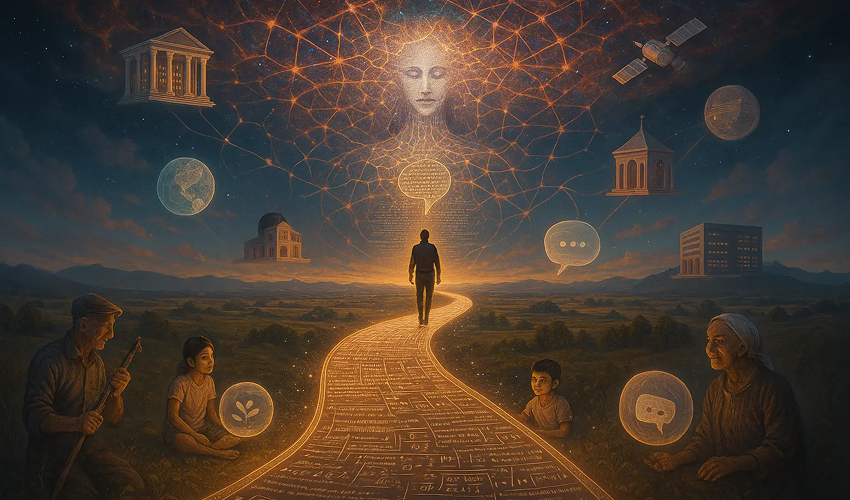
A new machine of thought. A tool that does not just store knowledge, it dialogues with it.
If the printing press birthed the Age of Reason and the internet birthed the Information Age, then LLMs may usher in the Age of Interactive Intelligence, where cognition becomes collaborative.
To speak with an LLM is to converse with the statistical shadow of human civilization. These models compress libraries, textbooks, forums, codebases, and centuries of discourse into something uncanny: a responsive companion.
It is the difference between holding a book and speaking with an author.
Between searching a database and interrogating the sum of its contents.
Between reading about the universe and co-navigating it.
With LLMs, expertise becomes ambient, available in real time, shaped by context, and adaptive to the mind asking the question. A farmer in Laos, a child in Nairobi, and a retiree in São Paulo can all suddenly access something civilization has never offered before:
A thinking partner.
The Shadow — Every Revelation Casts a New Darkness
Of course, every information revolution carries its storms.
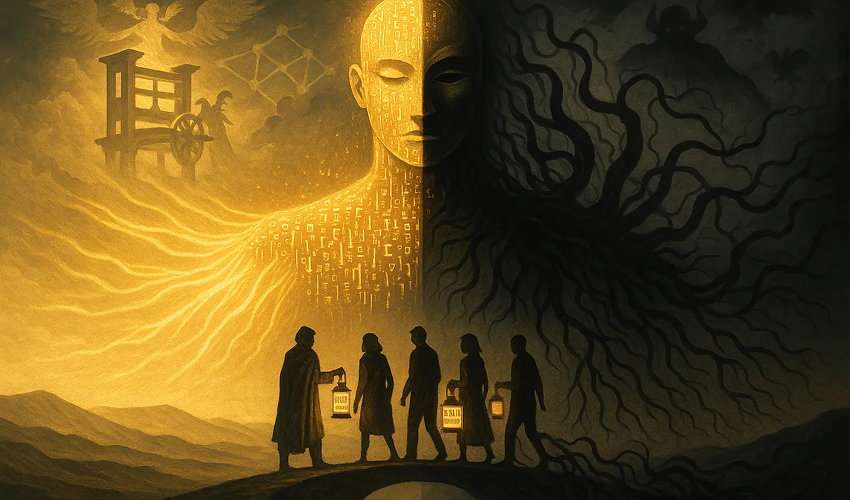
The printing press spread scripture and heresy. The internet spread knowledge and misinformation. LLMs bring clarity and hallucination. We now face a paradox: a machine that can uplift us or mislead us with equal fluency. It can accelerate innovation, unlock creativity, or scale propaganda at industrial speed.
History whispers:
“Every new portal carries both angels and monsters.”
The solution is the same as it was in 1450: not suppression, but literacy — a new kind of literacy. Not just reading text, but understanding its origin, its bias, its uncertainty.
A society that learns to think with AI without surrendering the ability to think about AI.
The Grand Event Moment
Stand at the intersection of these three turning points:
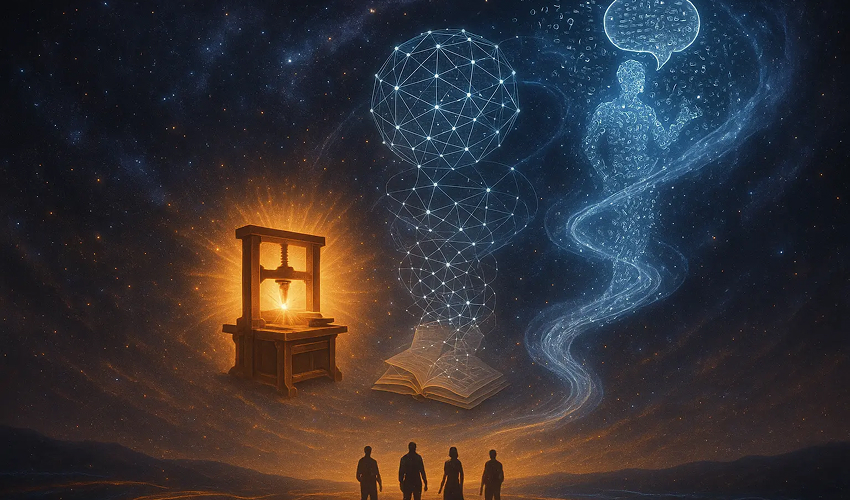
Print → Internet → LLMs.
Each wave unlocks a deeper layer of humanity’s collective mind:
- Printed information from monasteries.
- The internet freed it from geography.
- LLMs free it from format.
Now knowledge moves like music, fluid, improvisational, adaptive. We’ve passed from stored knowledge → networked knowledge → conversational knowledge. This is not just technological evolution; it is a civilizational metamorphosis. The universe is always writing, LLMs are simply the latest instrument.
What This Means for Us
The real revolution is not in the code, it’s in the redistribution of possibilities.
When anyone can access expertise, synthesize ideas, translate dreams into text or art or action, a new class of human potential emerges.
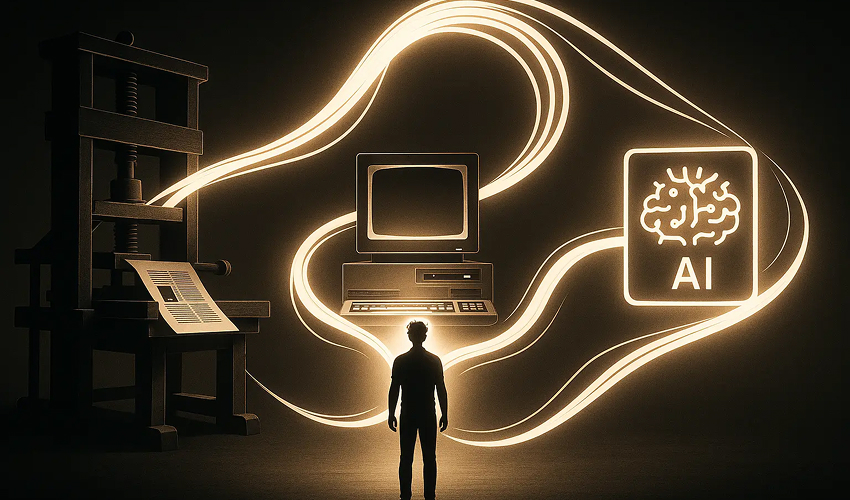
Gutenberg gave individuals the right to read, the internet gave them the right to publish, and LLMs give them the right to think with superpowers.
Ink, Light, Language
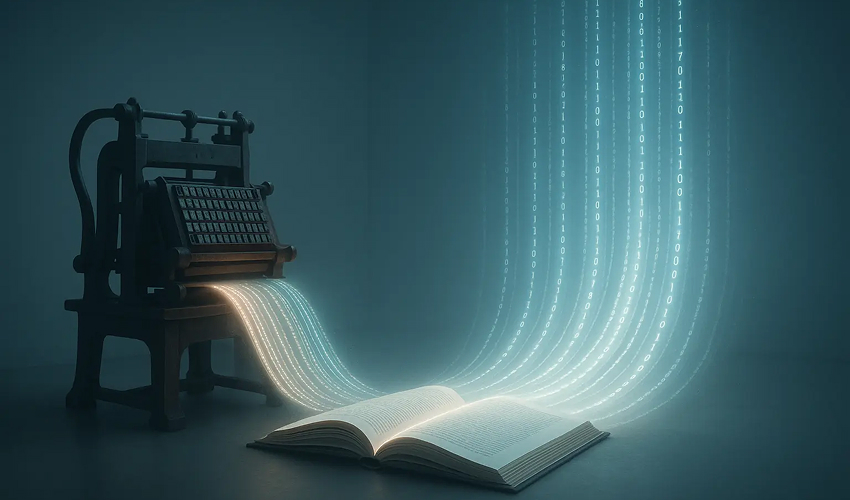
If Gutenberg held humanity’s future between metal type, we now hold it between lines of code.
Both inventions whisper the same truth:
“Knowledge wants to be free.
Understanding wants to expand.
Minds want to meet.”
We turn the page again, but this time the page is infinite, the ink is light, and the scribe is a machine that writes alongside us.
The story continues — not printed, not posted — but co-created in real time.
References
- Gutenberg’s message to the AI era | Brookings
- The Democratization of Knowledge and Technology: The Evolution of Humanity and AI | by christoschr97 | Medium
- LLMs: A Cognitive Revolution as Profound as the Printing Press and Internet
- 7 Ways the Printing Press Changed the World | HISTORY
- The Gutenberg Revolution of Large Language Models