
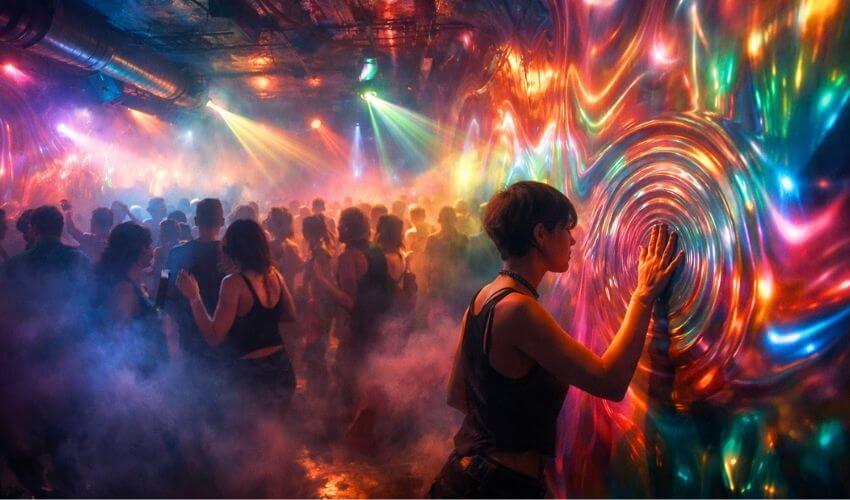
At 4:00 AM in a Berlin basement, the walls begin to disappear.
Not metaphorically. Not poetically. Literally, at least to the nervous system.
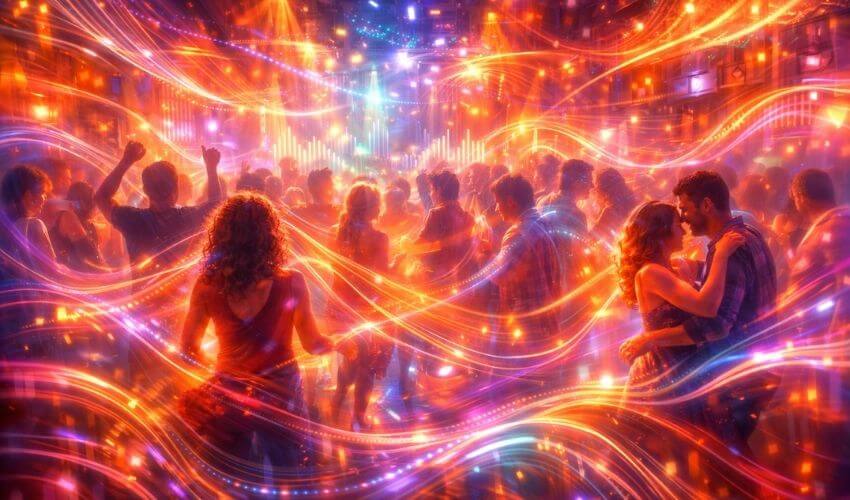
Concrete softens into motion. Light thickens into fog. The room exhales as the bassline tightens and compresses the air. A dancer near the back places a hand on the wall, not to steady themselves, but to feel it respond. The surface vibrates, shifting color in subtle gradients that follow the movement of bodies nearby.
You are no longer inside the space.
You are inside the pulse.
This is not décor. It is not a stage design layered onto a neutral container. It is not a spectacle added after the fact.
It is architecture behaving like a living organism.
Berlin’s club culture has long treated sound, space, and crowd as a single system rather than separate elements. As explored in this deep dive into techno’s evolution, techno did not emerge merely as a musical genre, but as a cultural technology shaped by repetition, feedback, and collective entrainment. What is happening now inside certain venues is a continuation of that lineage, translated from sound into space itself.
Why This Matters in 2026

By 2026, event spaces will no longer be static containers for sound and bodies. They are responsive systems that listen, sense, and adapt in real time.
Spatial computing no longer treats people as isolated points on a floor plan. It models movement as a volumetric field, a continuous flow of density, velocity, and rhythm. Bio adaptive lighting systems respond not just to tempo or brightness, but to heat, proximity, and collective motion. AI-driven control layers modulate sound diffusion, visual intensity, and spatial tension moment by moment.
The venue does not simply host the night.
It co-creates it.
This shift reflects a deeper transformation unfolding across technology and culture. Boundaries that once felt rigid are dissolving. The line between human and machine softens. The separation between observer and environment begins to feel provisional rather than fundamental.
Architecture, once obsessed with permanence and control, has gone liquid.
From Static Monuments to Living Systems
For most of history, architecture aspired to stillness.
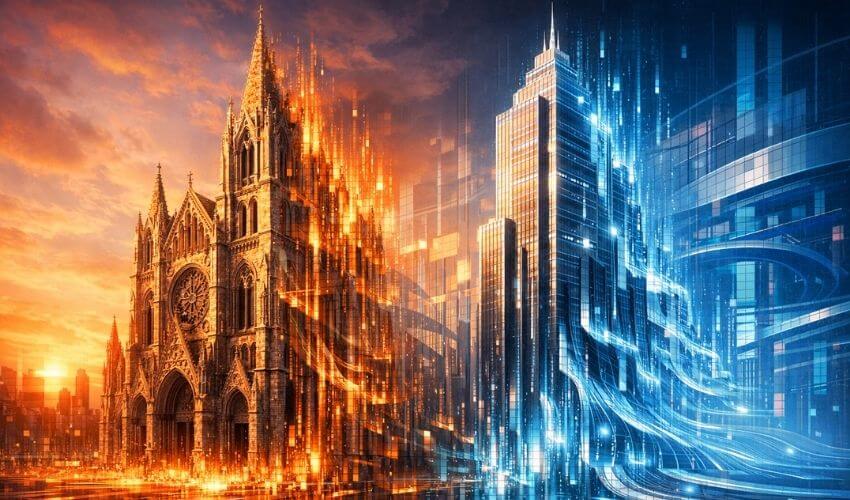
Stone cathedrals were designed to defy time. Steel skyscrapers signaled permanence through scale. Modernist concrete structures sought to optimize space for predictable patterns of use. Buildings were meant to endure, not to listen.
Yet beneath this desire for stability, another architectural imagination has always existed.
In the early twentieth century, Bauhaus thinkers began to treat buildings as systems shaped by human behavior rather than fixed monuments. By the 1960s, cybernetic architects like Cedric Price proposed structures capable of reconfiguring themselves in response to activity, mood, and social dynamics.
Price’s unrealized Fun Palace was not conceived as a building in the traditional sense. It was a framework for emergence. Walls could move. Programs could shift. Architecture existed to support participation rather than impose form.
The limitation was never conceptual. It was technological.
Sensors were crude. Computation was slow. Real-time feedback loops were expensive or impossible. These ideas remained speculative, waiting for the infrastructure to mature.
By the mid 2020s, that infrastructure arrived.
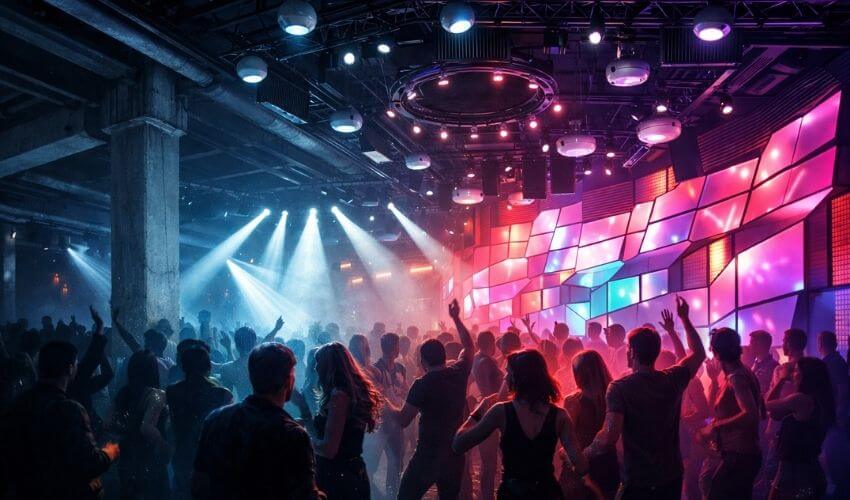
Low-latency sensors, machine vision, spatial audio, and generative AI converged. What once required massive budgets and experimental labs became modular, flexible, and scalable.
Generative venues are the inheritors of this unfinished lineage. They are not finished objects. They are ongoing processes, closer to software than sculpture.
Spaces That Feel You Back
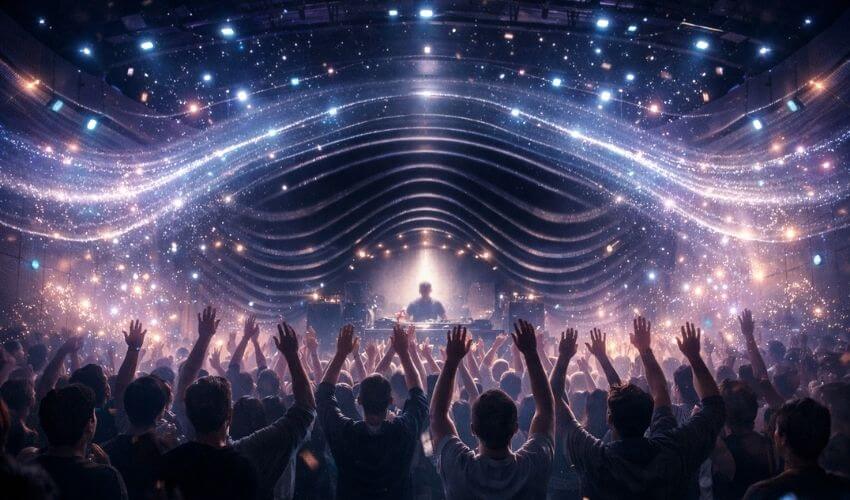
A generative venue functions less like a building and more like a nervous system.
Sensors act as senses. Algorithms become reflexes. Lighting regulates mood. Sound behaves like spatial choreography rather than static output.
As bodies cluster near the DJ booth, low frequencies tighten and darken, compressing the sonic field. When movement disperses, the room breathes outward, allowing reverb and delay to stretch across the space. During moments of collective synchronization, hands raised and breath held, the visuals soften or pause, as if the room itself is paying attention.
Nothing unfolds according to a fixed script. Instead, parameters define possibility. Thresholds trigger a response. Feedback loops stabilize or destabilize energy.
The room does not express an idea.
It is responding to a state.
Rhythm plays a crucial role here. Rhythm is not simply something we hear. It is something the body recognizes instinctively. As explored in this exploration of music’s abstract mathematical nature, sound operates as a structured pattern long before it becomes conscious meaning. Generative venues apply this same logic spatially, translating mathematical rhythm into light, movement, and architectural behavior.
Authorship shifts as a result. Designers no longer dictate experience directly. They design conditions under which experience can emerge.
Architecture becomes conversational.
The Crowd as a Distributed Mind
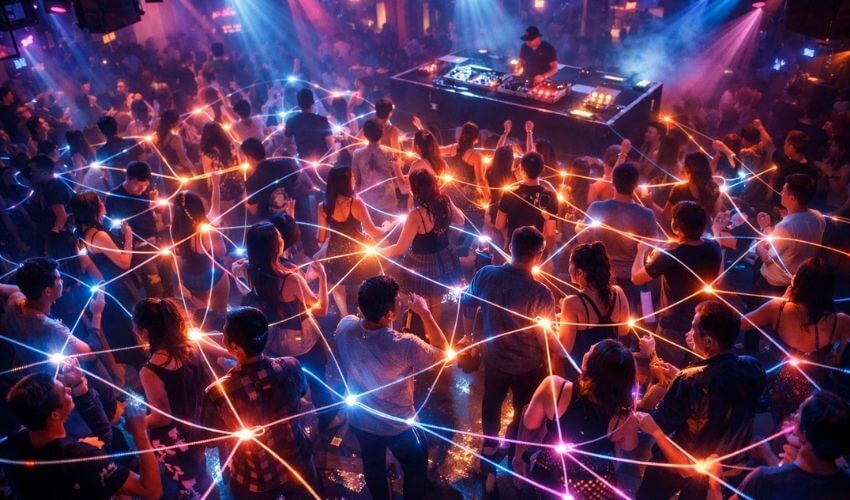
Club culture has always understood something that architecture is only now beginning to formalize.
The crowd is not an audience.
It is an instrument.
Long before sensors and machine learning, DJs learned to read micro signals from the dance floor. A shift in posture. A lull in movement. A surge of anticipation. Sound and bodies formed a feedback loop that guided the night.
Generative venues make this loop explicit.
Each person becomes a node in a larger system. Individuality does not disappear, but it becomes relational. Micro gestures aggregate into macro patterns. The system responds not to isolated actions, but to collective behavior.
This mirrors insights from neuroscience and philosophy alike. Consciousness is not located in a single place. It emerges from interaction, synchronization, and resonance across networks.
Inside a generative venue, the club becomes a temporary nervous system. The crowd becomes a distributed mind. The night becomes a self-modulating organism.
What emerges is not control, and not chaos.
It is coherence.
The Grand Event Moment — When Subject and Object Collapse
The most radical shift introduced by liquid architecture is not technological. It is experiential.
The boundary between subject and object collapses.
You are not experiencing the space as something external to you. The space is not manipulating you as an outside force. Both are arising from the same feedback loop.
This insight echoes familiar ideas from other domains. In quantum physics, observation alters the system observed. In non-dual philosophical traditions, the separation between perceiver and perceived is understood as a useful illusion rather than an ultimate truth.
Generative venues make this insight bodily.
Experience is revealed as relational. There is no isolated observer. There is no inert environment.
There is only interaction.
There is only flow.
The venue becomes less a place and more a condition.
Liquid Architecture as a Cultural Mirror
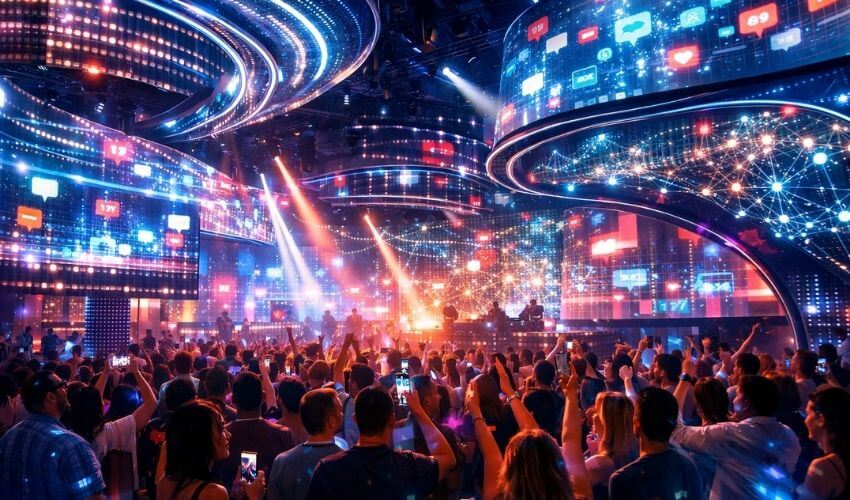
These spaces are not isolated novelties. They reflect a broader cultural transition already underway.
We live inside adaptive systems. Recommendation feeds respond to behavior. Interfaces learn over time. Intelligence increasingly unfolds through interaction rather than static output.
This same shift is explored in this examination of large language models and interactive intelligence, where meaning emerges through dialogue rather than delivery. Liquid architecture gives this condition physical form, translating abstract interaction into something felt in the body.
Static environments now feel outdated.
Generative venues resonate because they align with how people already live, think, and create. They transform complex systems theory into something rhythmic, social, and immediate.
You do not need to understand networks or emergence intellectually inside these spaces.
You feel them.
Designing Conditions, Not Outcomes
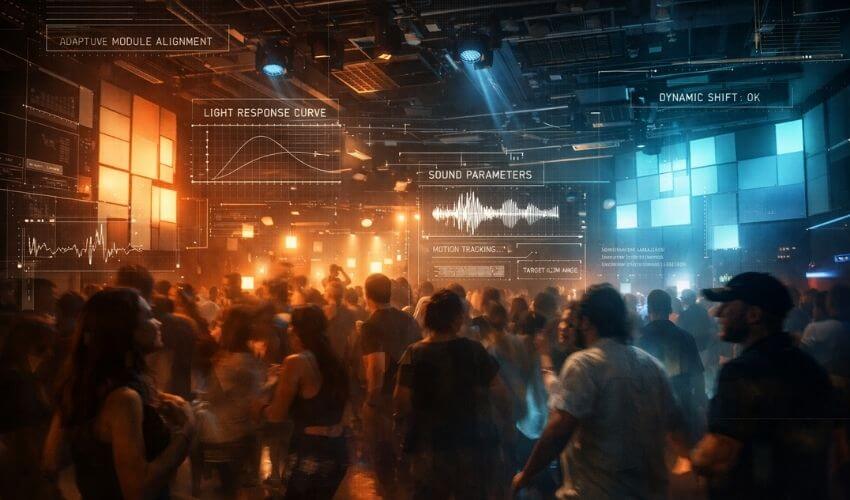
Liquid architecture demands a different approach to design.
Traditional architecture attempts to predict behavior. Floor plans anticipate movement. Sightlines guide attention. Materials enforce order.
Generative design does the opposite.
It defines ranges rather than outcomes. It establishes constraints rather than scripts. It prioritizes responsiveness over control.
Designers become curators of possibility. Success is measured not by visual coherence alone, but by how gracefully the system responds to the unexpected. A sudden surge of energy. A moment of stillness. A crowd that moves against prediction.
The most successful generative venues do not optimize for spectacle.
They optimize for listening.
A New Way of Being in Space
Liquid architecture invites a different posture toward technology.
Not domination. Not immersion.
Participation.
It asks us to recognize how much of reality is already co-created. How perception, environment, and meaning arise together. How experience is shaped not by isolated agents, but by relationships in motion.
The venue does not disappear.
Neither do you.
What dissolves is the illusion that either was ever separate.
After the Walls Return
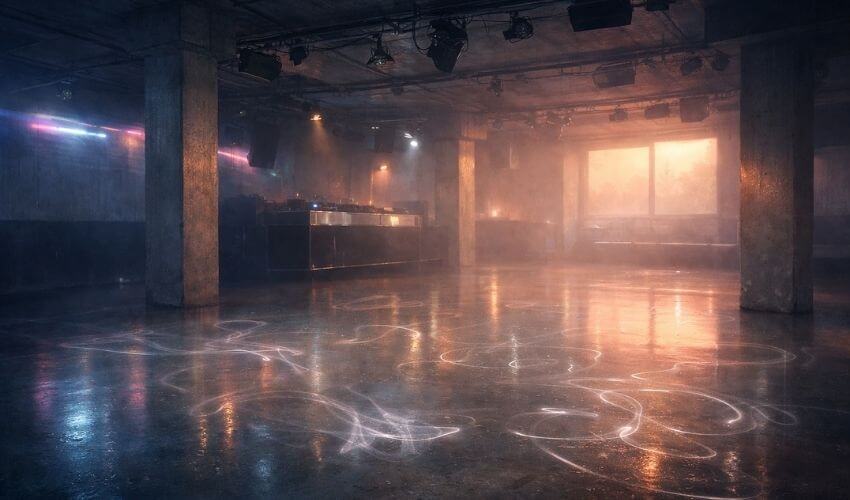
When the lights come up, the concrete returns.
The spell breaks.
But something lingers.
A memory, not of what you saw, but of what you were part of.
Architecture that listened. Technology that felt. A space that did not contain experience, but became it.
Liquid architecture is not simply the future of venues.
It is a reminder of something ancient.
That boundaries were always more flexible than we believed.
References
- Top Architectural Innovations to Watch in 2026
- Convergence Era: Embodied AI & Spatial Computing
- AI‑Driven Real‑Time Responsive Design of Urban Open Spaces
- Climate‑Adaptive Building Shell
- Performative Architecture
- The Future of Architecture Through Spatial Computing
- Adaptive Rooms Interpreting Collective Internal States